-
 Field House, High Street, Wadhurst, TN5 6AQ
-
Follow Us on:


Dental Crowns Durgates & Tunbridge Wells
- Home
- /
- Treatments
- /
- General Dentistry
- /
- Ceramic Onlays and Crowns


Weak teeth will often need a ceramic onlay or crown to strengthen them.
Ceramic onlays are used when a tooth has been fractured, has a large filling or a significant crack.
Ceramic crowns are used to protect and restore a broken, weakened or heavily filled tooth. They can also be used to improve the appearance of discoloured or crooked teeth.
Crowns can be colour-matched to your existing teeth, giving them a natural appearance. We routinely use digital photography to ensure the best colour match possible, giving your smile a uniform look.
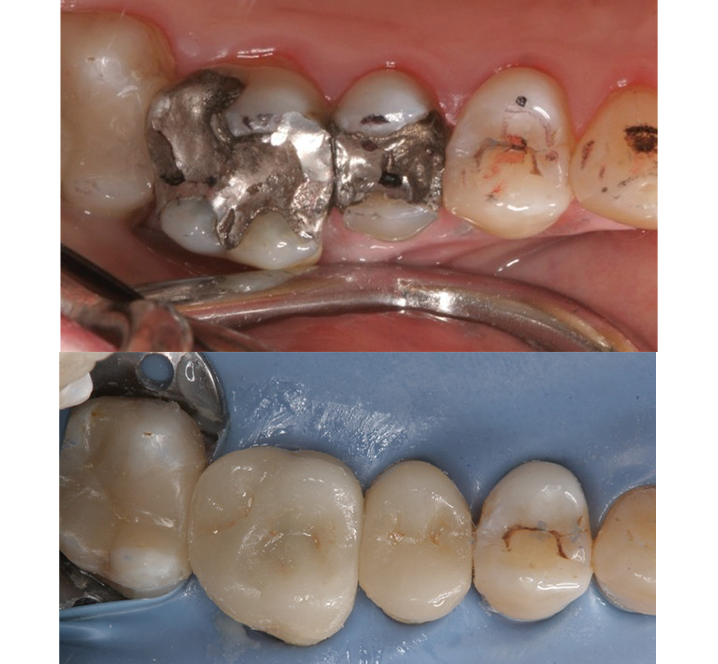
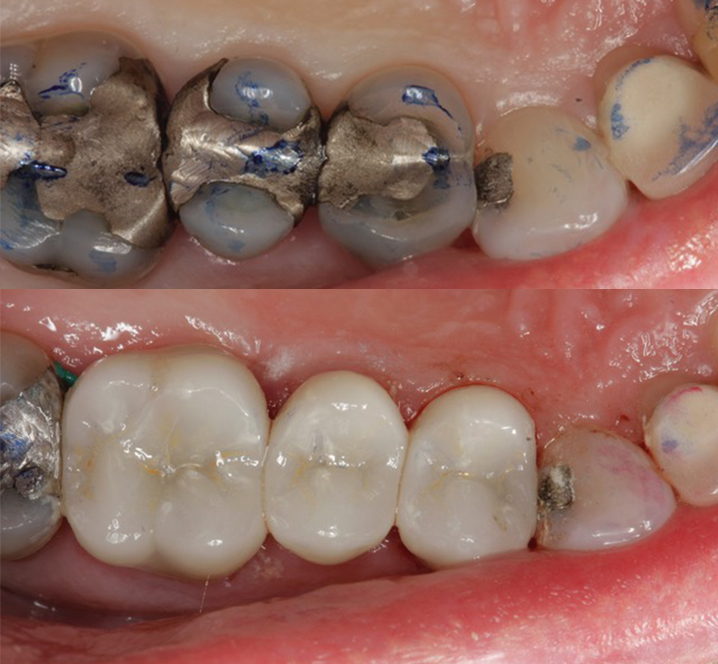
When a tooth has an existing filling due to previous damage or tooth decay, further treatment can often be necessary to mechanically strengthen the tooth, prevent further parts of it from breaking off, or protect it from splitting. This is especially important if a tooth has had a root canal treatment.
Ceramic Onlays
Ceramic onlays offer all of the benefits of a crown in terms of strength and appearance, but require less adjustment of the tooth. This can be an effective way to ensure more of the healthy tooth structure is kept intact.
The onlay is adhesively bonded to the natural tooth, making it very strong. For a successful onlay to be placed, it must be possible to keep the area being treated dry. Where this isn’t possible, a traditional crown might be a better alternative.
Many teeth that have required extensive fillings can experience a loss of their original strength, and ceramic onlays can be an effective way to restore weakened teeth. We ensure the restoration is tooth-coloured, so you don’t have to worry about the onlay affecting the aesthetics of your smile overall.
One of the main advantages of an onlay is that it’s a more conservative choice than a crown, because it only restores the damaged areas. This means that less natural tooth structure needs to be removed during preparation for an onlay.
Ceramic Crowns
Ceramic dental crowns offer the same degree of protection as an onlay, and have been a go-to treatment for many patients traditionally. Crowns offer greater overall protection, and we’ll often recommend them for teeth that are heavily filled, cracked, or weakened, as they help hold the entire tooth together.
However, crowns do require more shaping of the tooth in preparation than onlays do; this is so the restoration can fit over it completely. As a result, more of the original tooth is removed compared to an onlay. Because of this, we have to ensure that the original tooth has enough structure to hold a crown in order to be a viable long-term solution.
How do you choose between a crown or onlay?
Ultimately, we make the choice between using an onlay or a crown depending on how much healthy tooth remains and how much support the tooth needs. Onlays are preferred when there’s sufficient tooth structure still intact, while crowns are better suited for cases where maximum coverage and protection are required.
Examples of when we might suggest a crown could be if you’ve had root canal treatment. The tooth becomes more brittle over time after having its nerve removed, and a crown is often preferable as it will completely cover and reinforce the weakened tooth. In this case, we’ll suggest a crown because its full coverage provides strength, restores function, and will last longer in the long term.
Whereas we might recommend an onlay when a tooth has a large cavity or an old filling that has weakened one or more of the cusps (the raised points on the biting surface), and there’s still a good amount of healthy tooth remaining. Instead of removing more tooth to place a crown, an onlay can reinforce only the affected areas.
Everyone’s situation is specific to them, so we always review our patients’ needs on a case-by-case basis. We want you to be happy with the choice we make and fully informed as to why we’ve made it.
Cracked Teeth
Another situation where an onlay or crown is strongly advisable is when a tooth has fracture lines, implying that there is a crack running through the tooth. In this case, the placement of an onlay will cover the tooth and protect it from splitting in half.
The placement of an onlay or crown will mechanically strengthen the tooth and prevent it from breaking or splitting. If the tooth has a crack in it or already has a large filling in it, there’s a chance that the tooth may need to have a root canal treatment. This may be required whether or not the tooth is restored with an onlay or crown.
The Treatment Process
The provision of a crown or an onlay will typically involve two visits.
Visit One
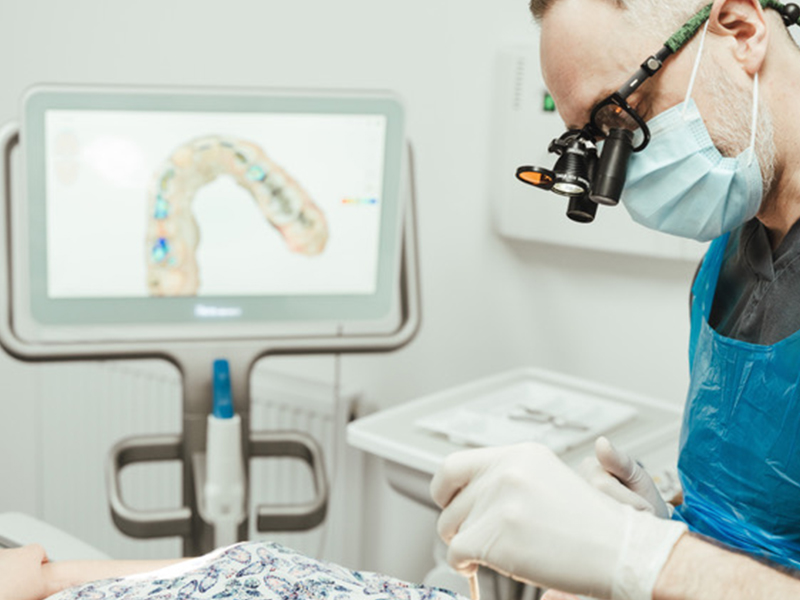
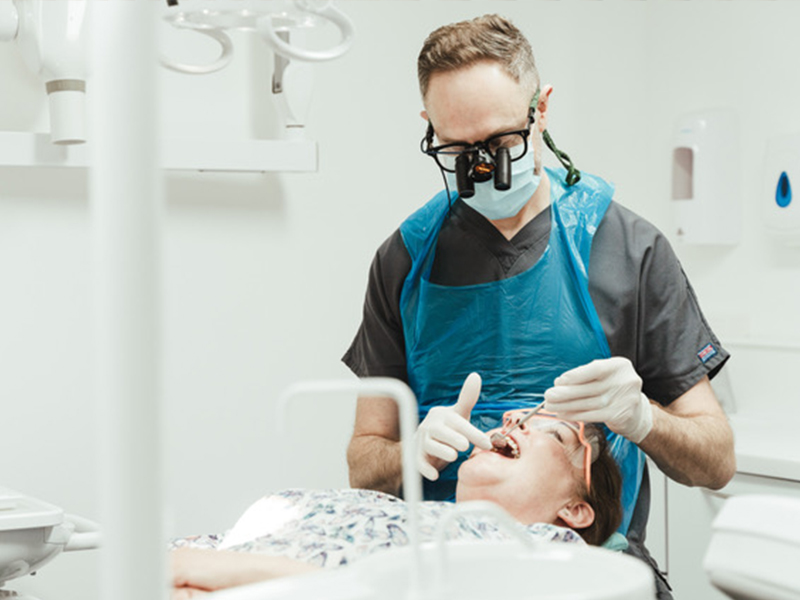
At this visit, the tooth will be prepared and reduced in size in some respect to create space for the restorative material, whether this is a crown or an onlay. This is carried out under local anaesthetic, and on most occasions, a colour digital intra-oral scan will then be carried out, which is digitally transferred to our dental laboratory. They will then make your restoration bespoke and ready for fitting on the second visit. On some occasions, a digital scan may not be possible, and a conventional impression or mould of the teeth will need to be taken instead. A temporary restoration will be fitted at this initial appointment. You will need to be careful to eat a softer diet during the two-week period between the two appointments, and your normal cleaning routine may also be slightly different. It is also not unusual to experience a degree of sensitivity to temperature when the tooth has a temporary restoration.
Visit Two
At the second visit local anaesthetic will be provided again. The temporary restoration will be removed and the tooth cleaned. The final crown or onlay will then be cemented in place, and it is likely that some degree of adjustment will be required to ensure that your bite is comfortable. Again, it’s important to be aware that your regime for cleaning around and between the new crowns or onlays may be slightly different. For example, you may need to use slightly different-sized Tepe brushes from the size you were using in the area before the restoration was placed.

Get in touch
We provide a simple and affordable way to pay for dental treatments, enabling you to arrange the smile you want at a cost to suit your pocket.



testimonials
We love our patients

“I've just finished invisalign straightening and bonding with Chris and I'm so pleased with the results. I am not sure why I didn't do this years ago as it has improved my confidence so much. I no longer cover my...”
Louisa L
“I am extremely happy with the expertise and quality of work evident during my recent visit to Ibbott&Co Dental Clinic. The replacement filling I had looks great and I felt no pain whatsoever during the procedure or since, I'm pleased...”
John W
“I joined Ibbott&Co in January with a view to changing my 2 front crowns which I'd had for over 15 years. After a thorough examination and an in depth consultation with Chris, we decided to change the crowns, and also...”
Linda P
“I had my first appointment with Janet today and she is fantastic! All the staff at Ibbott&Co are so friendly and caring. The best, most reassuring experience I have had at a dentist and I feel in safe hands. Thank...”
Jasmine M
“I was always very conscious of my teeth and like many people held back my smile as a result, and my fear of dentists and the thought of long painful appointments meant I did nothing about it. After talking through...”
Martin B

Book a Cosmetic Consultation